COLCA CANYON - Almost Twice as Deep as the Grand Canyon
Published on Anja Tags: Colca Canyon

COLCA CANYON - Almost Twice as Deep as the Grand Canyon
Accommodation
The entire three-day tour was organized by the agency. Consequently, the accommodations were pre-selected and included in the final price.
The first night was in San Juan de Chuccho at "Posada Gloria." Very nice! The food was super delicious, and we had two small huts where we slept. Since only four of us took the three-day tour that day, we had a guide to ourselves. Rafael was about 55 years old and had been exploring the Canyon for a long time. I shared a room with Babette, while her boyfriend and another participant shared a second one. We could use the solar shower in the afternoon and paid a total of 5 soles for the internet. In the evening, there was also internet available to charge our phones. The starry sky at "Posada Gloria" was simply unique, and we could even see the Milky Way.
The second night was then in Sangalle. There we stayed in the first accommodation upon entering the town, "Palmeras Oasis." Quite nice! There was a pool, and everyone had their own little hut. The food was solid, and there was a very fluffy, huge dog who accompanied us a bit on the ascent from the Canyon the next day. He even got to the top before us!

SIM Card
We didn't have network coverage in the Canyon, but in the first accommodation, we could "buy" the internet, and in the second one, it was provided free of charge.
Attractions
"Depending on whether you measure the depth of the Canyon from the highest mountain peak right at the gorge down to the Río Colca or from the edge of the gorge, the Colca Canyon is between 3,400 m and 1,200 m deep. The Grand Canyon, on the other hand, is only about 1,800 m deep. Thus, the Colca Canyon is, after the Tara River Canyon in Montenegro at 1,300 m, the third deepest canyon in the world.” So, pretty impressive, especially for such a "young" Canyon that is less than 100 million years old.
In the Canyon, you can see both rock paintings and caves. In the caves are the so-called "Colcas," storage containers for grains from the Collagua culture, the original inhabitants of the Canyon. Some caves were also used as cemeteries. On the way from Arequipa, you can see centuries-old terraces on the upper slopes of the Canyon, which people used for agriculture.

Getting Around
At the beginning of the tour, we were brought in a transporter or sprinter, and within the Canyon, we logically moved on foot. From the endpoint, we were then brought back to Arequipa in a sprinter (we basically had a VIP vehicle) with a few stops in between. We also had the option to stop somewhere in between — our driver was really great.

Food and Drink
For breakfast, we had traditional Peruvian items: Mate de Coca, coffee, rolls, butter, jam, etc., at Tusuy Wasi in Chivay. We were also treated to a show by two local dancers, and some tour participants were even urged to join in the dancing 😂. Very funny :D For lunch, we were then already at our first accommodation: as a starter, a salted cracker with guacamole and tomato, then a quinoa soup, and as the main course, a variation of "Lomo Saltado" with alpaca meat with fries and rice. For dinner, we had a noodle soup and "Pastel de Papa" (potato cake) with pork and beans. The breakfast on the second day was particularly delicious: crepes with chocolate sauce and bananas. Fortunately, the bananas could be removed from my crepe without residue 😮. Then a fried egg in a pepper slice and half an avocado (from the local tree) with a salted cracker. In the second accommodation (Palmeras Oasis), it was a bit less tasty. For lunch, we had pork with rice, fries, cucumbers, and tomatoes. And for dinner, there was chicken with rice, potatoes, carrots, and beans. We had breakfast on the third day after our ascent from the Canyon in Cabanaconde: coffee, tea, rolls, jam, and egg. We had to take care of lunch ourselves in Chivay. I actually wanted to eat at the market, but we were then brought to a restaurant where everything was quite expensive. I decided to eat my last apple since I wasn't very hungry anyway. Luckily, one of the fellow travelers wasn't very hungry either, and I just had the rest of his fries. And that was more than enough!
Cafes and Restaurants
- Tusuy Wasi in Chivay
- Posada Gloria in San Juan de Chuccho
- Palmeras Oasis in Sangalle

Tour Schedule
Thanks to Moritz (whom we met on the Iberá tour), I got a lot of information about the schedule and difficulty level. I decided to join a tour and not organize it on my own. After all, I was traveling alone, and it wasn't that expensive. My hostel, a.k.a. Hilda, organized everything with Andina Travel for 200 soles.
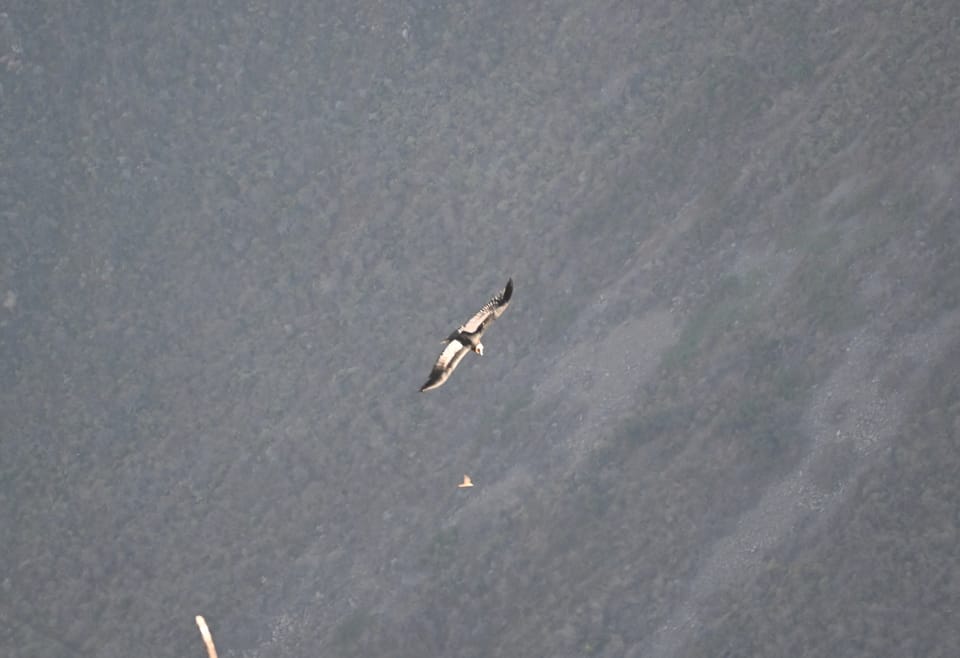
The tour started at 3:00 in the morning. We picked up a few more people in Arequipa and then left the city, fully booked to the last seat. At 6:30, we had breakfast and a dance performance. On the way, I also caught a glimpse of the sunrise and the "Mirador de los Volcanes." We continued and around 8:00, we arrived at the "Cruz del Condor." This is a viewpoint where you can observe the circulating condors in the morning. I was lucky and could take some photos. Unfortunately, the three-meter-tall birds were also quite fast. At 10:30, five of us started our hike with our guide Rafael. He explained the history of the region and some plants at the "San Miguel" viewpoint. Then our entrance ticket of 70 soles was checked, and we were asked to start walking ahead. We met Rafael again when we were almost all the way down and finally relaxed for half an hour at the Colca River — Babette even dared to go fully into the ice-cold water, and Teddy did so halfway ;). Then it was a relatively easy walk to the accommodation. We dropped off our stuff and at around 14:00 had our lunch served. The rest of the day was free, and everyone read their books (I read on my phone, the other three had physical books with them). We showered and relaxed in the evening under a fantastic starlit sky. Babette shared the room with me, and before going to sleep, we first had to banish a few insects outside so she could relax :).
The next day, we had breakfast at 7:30 and started our hike within the Canyon from accommodation to accommodation at 8:30. We passed alpacas, avocado trees, and various interesting plants. We also went through the villages of "Cosñinhua" and "Malata." We had a steep climb of about 40 minutes — our "test" for the third day. We passed and reached the bridge leading to the oasis at 11:30. At around 11:45, we arrived at the accommodation. Everyone got their own hut, and the others began to splurge in the pool. I had a stomachache and relaxed in my hut until lunch at 13:00. Afterward, I dared to take a short dip in the pool and sunbathe a bit. Then it was time for dinner again, and I chatted a bit with the others and another traveler from the USA. A bit more reading and then off to bed.
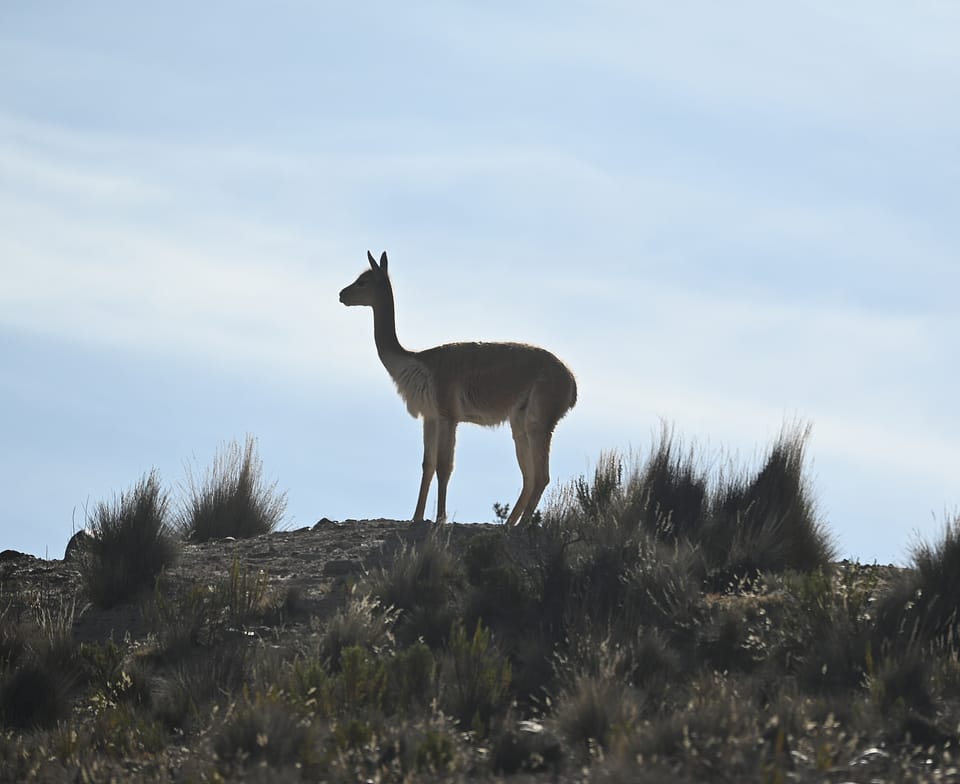
At 4:35, we started the climb out of the Canyon — Jonas felt really bad as he had suffered a severe sunstroke the day before. We were one of the first groups and thought halfway that we were almost at the top — wrong! We kept overtaking and being overtaken by the same people, seemingly having a similar pace. Even the dog from our accommodation was with us on the trail. Others decided to ride a horse up from Sangalle, starting at around 5:30. Really impressive how hard the animals have to work. We were overtaken in the dark by the horse group and got a fright... Then came the spectacular sunrise, which we could only see from the corner of our eyes. After all, we had to finish the climb within the time. Teddy was the first to arrive, and at 7:48, Babette and I also reached the top. Within 3h 13min, we had climbed over 1000 meters of altitude. Shortly after, Jonas and our guide arrived. Some had a coffee at the top; we were supposed to move directly to breakfast. That took place in a "restaurant" in the city. Our dog followed us there! 😂 Then we strolled to the main square and waited for our transport — a relative of our guide! We got in and were taken to the hot springs in Chivay. There we bathed in hot springs, and Babette and Teddy jumped once more into the ice-cold Colca River. While bathing, we also watched people ziplining over the water. Then it was off to the restaurant and then to the "Mirador de los Volcanes — Tramo de la Cordillera Volcanica en los Andes Centrales" at 4910 meters. There we had a view over the geopark "Colca y Volcanes de Andagua" and many volcanoes over 6000 meters high. A bit of relaxing, a penultimate stop at an alpaca herd, and a brief stop at a small group of vicuñas. And then off home! Around 18:00, after an incredibly varied landscape and a long journey through the outskirts of Arequipa, we arrived and said our goodbyes. Pascal and I then went for a nice dinner and then treated ourselves to drinks at the upscale Pisco Museum. And finally, sleep ;)

Flora and Fauna
- Sancayo cactus / Corryocactus brevistylus (slender, tall, unbranched)
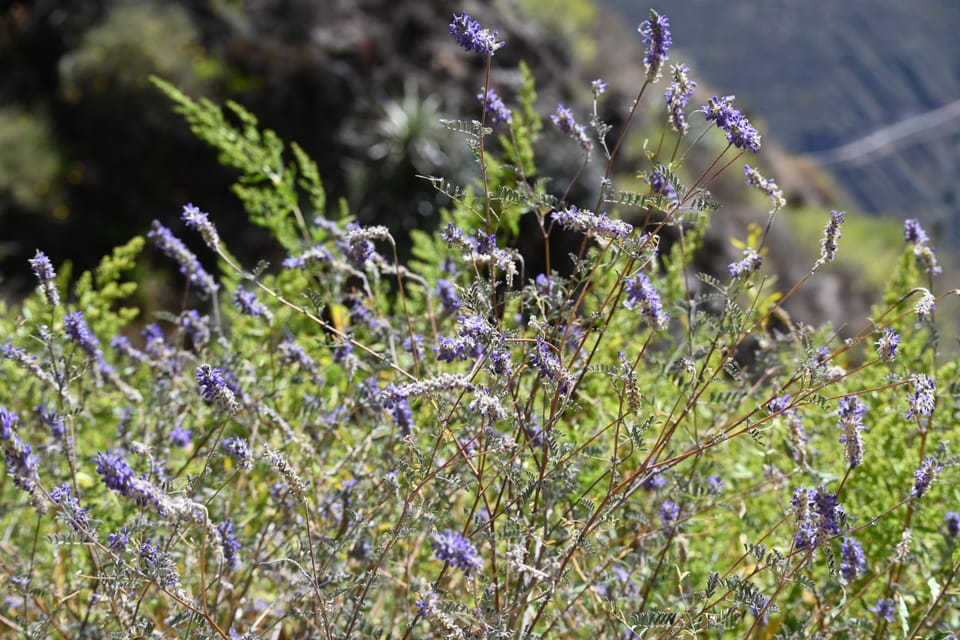
- Andean lupine / Lupinus Mutabilis (purple flowers)
- Sheep-eating plant / Puya Chilensis (evergreen, spiky bromeliad, edible)
- Mutchki / Vasconcellea candicans (coffee-like fruit)
- Bolivian Torch Cactus / Echinopsis lageniformis (slender, tall, branched)
- Minthostachys mollis (Muña, medicinal plant, tea)
- Dalea coerulea (purple flowers)
- Barbary Fig / Opuntia ficus-indica (prickly pear) On the second day:
- Peruvian pepper tree / Schinus molle (medicinal plant)
- Century plant / Pita / Agave americana (agave, evergreen)
- Blue myrtle cactus / Myrtillocactus geometrizans (segmented)
- Cherimoya / Annona cherimola (edible)
- West Indian canna / Canna indica (yellow or red flower)
- Melon tree / Carica papaya (tall)
- Banana / Musa acuminata And on the third day:
- Parry’s marina / Marina Parryi (purple flowers)
- Condors
- Vicuñas
- Alpacas
And a few different birds.


Number of Germans in the Canyon
We only met another German-speaking couple. The rest were mostly from the Netherlands and Italy. We also met a young American with a strong accent (just turned 18) who wanted to climb out of the Canyon in two hours — and he actually made it.
Interaction with Locals
We talked a lot with our guide Rafael. He was very friendly, but I had the feeling that he didn't really like us ;) And I was too slow for him anyway, that much was clear 😂.

People Met
Three other people did the three-day tour with me:
- Babette and Jonas, her boyfriend (both from the Netherlands)
- Teddy (from the UK, specifically London) On the two-day tour, about 25 people shared a guide — luckily, I chose the three-day option!
Expenses
The entrance to the Canyon cost 70 soles. Within the Canyon, I bought overpriced (but very necessary) water. In Chivay, I also paid 15 soles for entrance to the "Aguas Termales la Calera."
Standard Stall Offerings
- Hats, scarves, ponchos, sweaters
- Dolls and Barbies
- Traditional embroidered hats
- Embroidered bags
- Ice creams for 3 soles each
- Sancayo (cactus)
- Aguaymanto (physalis)
- Lúcuma (lucuma)
- Chirimoya (cherimoya)
- Mango (mango)
- Fresa (strawberry) If I had known that there was an endemic cactus variety used to make ice cream, I would have grabbed it immediately! And then so cheap — 72 cents!
Unsolvable Mysteries
Why does our guide Rafael always wait for German hikers who no longer need their hiking boots? He wants to buy them and says that Germany has the best quality, but honestly — how likely is this to happen?
Bus to Arequipa
We had our bus to Arequipa to ourselves and could spread out and sleep a round. Around 18:00, we arrived exhausted in Arequipa, and for Babette, Jonas, and Teddy, the journey continued to Cusco or Ica! I had already been there :) And as we learned in Quechua: "¡Haku haku!" or in German, "Let's go!" ❤
Post Scriptum
Find more pictures again at: https://hoenisch.eu/photo/mo/sharing/B5iT5e8jK